

AWS WorkSpaces vs Azure Virtual Desktop: 86% Cost Cut
By Chrysillis Collier · July 13, 2026
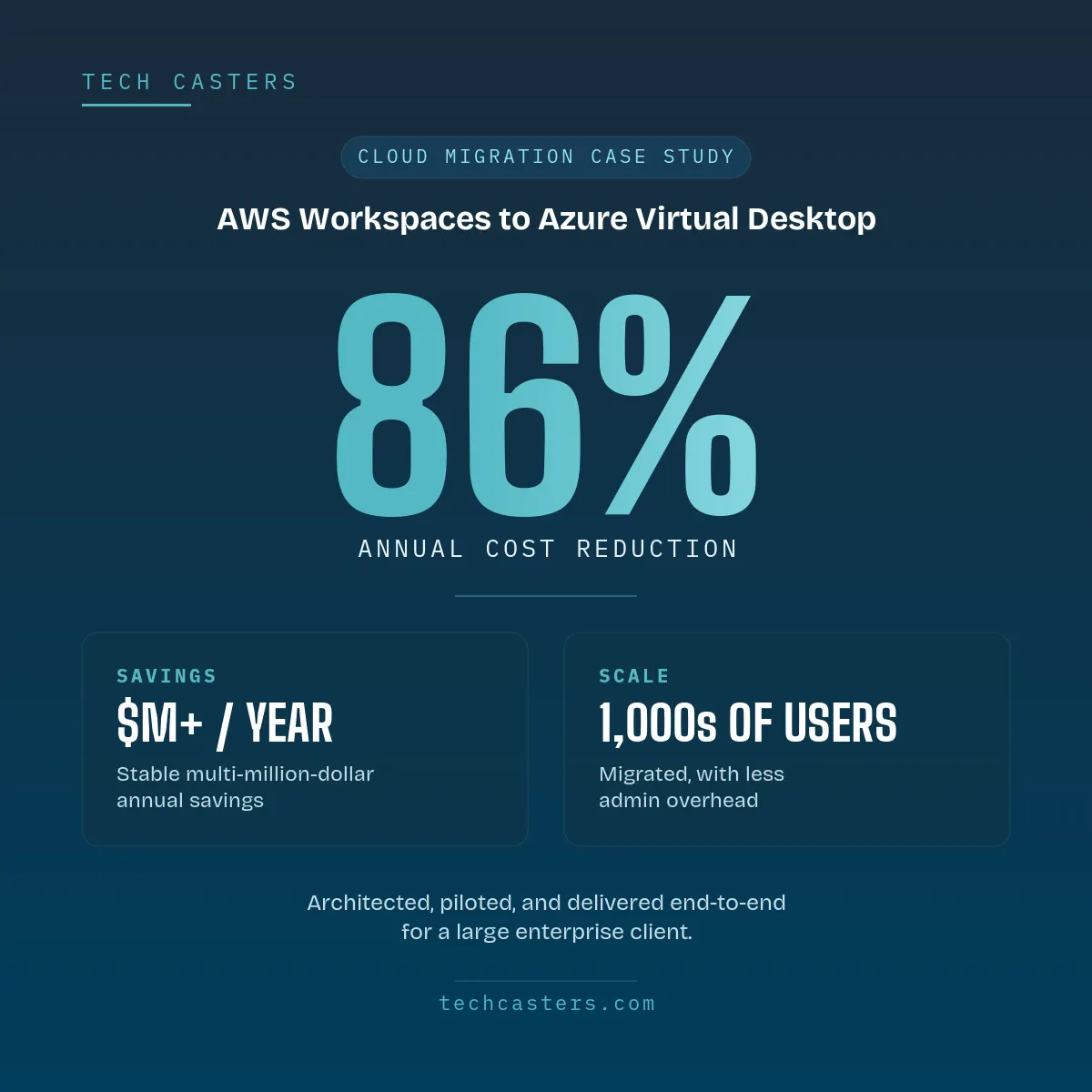
Before founding Tech Casters, I worked as an independent contractor on a project that has stuck with me ever since: helping a large enterprise client move thousands of remote users off AWS Workspaces and onto Azure Virtual Desktop. It is one of the clearest examples I can point to of what happens when a virtual desktop environment is treated as an afterthought instead of a proper architecture.
The Problem
The client was running every user’s virtual desktop on AWS Workspaces: one personal desktop per person, with no shared infrastructure and no standardization behind it. In practice, that meant:
- Inconsistent onboarding, with no repeatable process for getting a new user up and running
- No standardized software image, so every desktop was configured a little differently
- Desktop management handled through custom scripts that were never backed up or version controlled
- No shared desktop pools, so every single user carried the full cost of their own dedicated infrastructure
None of these problems looked dramatic on their own. Together, they added up to an environment that was expensive to run and genuinely risky to maintain, since so much of it lived in scripts nobody had documented.
The Approach
I was brought on to architect and pilot a new Azure Virtual Desktop environment, to test whether a full migration off AWS Workspaces was actually viable, not just cheaper on paper. That meant building shared desktop pools, standardizing the base image, and putting real onboarding and management processes in place before asking the organization to commit to switching over.
The pilot held up well enough that the client moved its entire user base to AVD, then kept adding more users as other legacy environments, including an on-premises Citrix setup, were retired in favor of it.
The Results
The cost difference showed up immediately. Within the first full year on AVD, even while supporting substantially more users than before, the client’s costs dropped by roughly 82% compared to what they had been paying for AWS Workspaces.
That first-year figure still included the overhead of a system in transition, with departments migrating on their own timelines and the environment still being tuned. Once things stabilized and further optimization work went through, the reduction settled at a full 86% against the original AWS Workspaces spend, a stable, multi-million-dollar annual savings. Continued optimization over the following year brought costs down further still.
Beyond the direct savings, the new environment simplified administrative overhead, tightened security, and cut new user onboarding time dramatically. That kind of operational improvement does not show up on a savings chart, but it matters just as much day to day.
Why This Matters If You’re Evaluating AVD
Cost savings on paper and cost savings that hold up in production are two different things. What made the difference here was not simply choosing AVD over AWS Workspaces, it was resisting the urge to lift and shift the same one-desktop-per-user model onto a new platform. Shared pools, a standardized image, and documented, version-controlled management were what actually made the numbers work, and without them the switch would have accomplished far less.
This project was completed as an independent contractor prior to founding Tech Casters. Details have been anonymized at the client’s request; the architecture, approach, and results described are accurate.